
- Growth of organic search traffic.
- Increase in the number of keywords ranking in the TOP 10.
- Improvement of on-site user engagement metrics.
1. Project Overview
Niche: Regional Commercial Project (E-commerce / Services).
Pre-launch status: The website was in a state of stagnation. Despite having a high-quality product, search engine traffic accounted for less than 15% of total visits. The majority of traffic consisted of branded searches.
2. Identified Issues and Growth Barriers
During the initial audit, our experts identified several critical factors hindering growth:
1. Indexing Errors.
Due to a misconfigured robots.txt file and page duplicates, essential commercial sections were not being indexed by Google.
-
- Impact: important pages were invisible to non-branded search demand.
2. Structural Issues.
The lack of a clear page hierarchy prevented the effective distribution of internal authority.
-
- Impact: authority signals were not routed to the most valuable landing pages.
3. Content Problems.
Existing content was written without considering current semantic clusters or user intent.
-
- Impact: pages were not matching search intent and therefore struggled to rank.
3. Goals and Objectives
- Reach Expansion: 2.5x growth in non-branded organic traffic.
- Visibility: reaching Google’s TOP 10 for 80% of the priority keyword pool.
- Technical Health: resolving all errors in the Google Search Console and optimizing Core Web Vitals metrics.
4. Implementation: Step-by-Step
Step 1: Technical Foundation and Speed Optimization
SEO begins with technical integrity. We performed a complete website «hygiene» process:
- Canonical tags: configured rel=»canonical» to eliminate duplicate pages.
- Speed optimization: optimized scripts and images, achieving «Green Zone» scores in PageSpeed Insights.
- Heading structure: corrected the H1-H6 heading structure across all page templates.
Step 2: Designing a New Semantic Architecture
We moved beyond focusing solely on high-volume keywords. Our team gathered over 1,500 keywords, including:
- Transactional queries: containing words like «buy,» «order,» «price».
- Long-tail keywords: highly targeted traffic with high conversion potential.
Based on this data, we expanded the menu structure and created new landing pages.
Step 3: Content Marketing and Intent Matching
We implemented a fresh approach to content creation:
- Intent-first content: every article or product description fully addresses specific user questions.
- Schema.org markup: integrated Schema.org which enabled rich snippets (star ratings, price, availability) and boosted CTR.
Step 4: Authority and Link Building Strategy
Domain reputation is critical for Google. We developed a safe link-building strategy:
- Guest posting: placing guest posts on authoritative, niche-relevant portals.
- Natural backlinks: acquiring links from specialized forums and communities.
- Quality control: strict avoidance of rented links or low-quality platforms.
5. Final Results
After 6 months of systematic work, we recorded the following metrics:
| Metric | Result |
| Traffic | Total search traffic growth reached +150% (a 2.5x increase) |
| Conversion | Search-to-lead conversion rate increased by 22% |
| Rankings | 82% of keywords from the priority pool secured positions on the first page of Google |
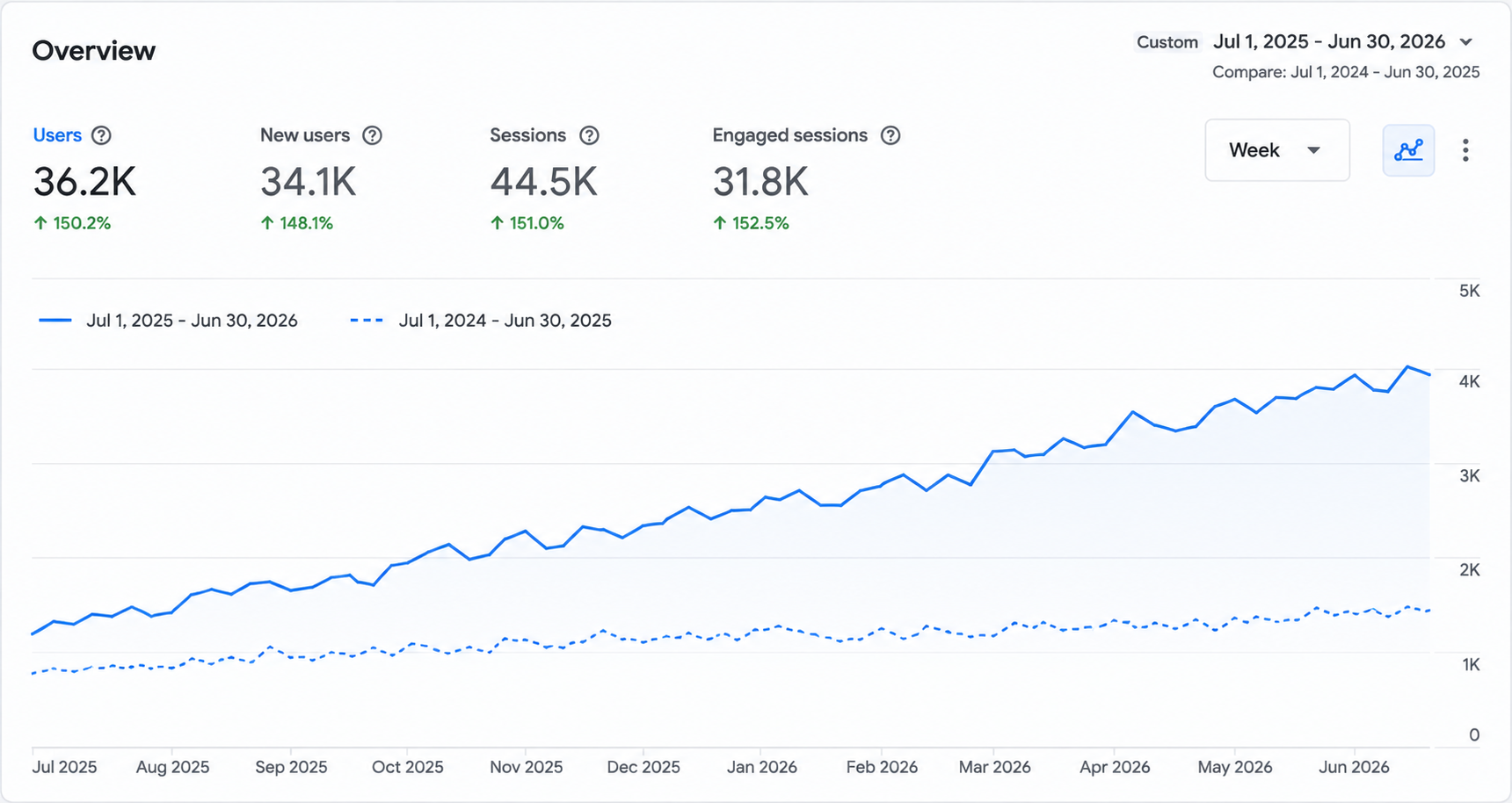
6. Results Verification
Google Search Console: “Performance” chart showing the growth in clicks and impressions.
Topvisor: a screenshot from the rank tracking module confirming keywords entering TOP 3, TOP 5, and TOP 10.
GA4 (Google Analytics 4): a traffic source report documenting growth in the Organic Search segment.